
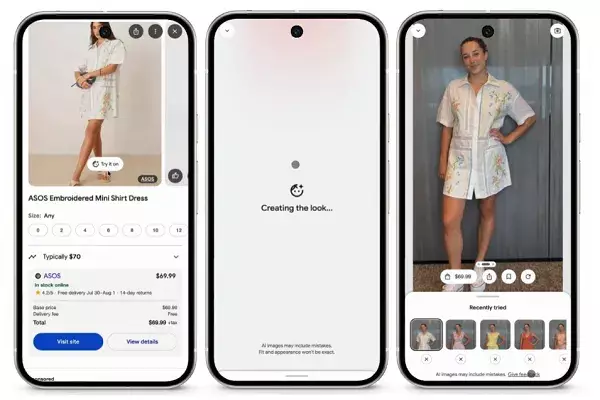
In the rapidly evolving world of e-commerce, standing out requires more than just a vast product catalog. Google’s latest innovations aim to break down the barriers between digital and physical shopping experiences through cutting-edge AI tools. One of the most transformative features is the advanced virtual try-on system, which allows consumers to visualize clothing on themselves with unprecedented realism. By leveraging personal selfies, users can virtually see how garments might look when worn, addressing a long-standing challenge in online shopping—uncertainty about fit and appearance. This move signifies a remarkable shift toward personalized, immersive shopping, but it also invites scrutiny regarding claim accuracy and user privacy.
While the convenience of uploading a selfie for instant visualization is impressive, questions about the realism of these previews must be considered. Will these digital representations truly reflect how clothes fit and move on real bodies? Or will they oversimplify or distort the user experience, leading to misplaced confidence? These tools have enormous potential but are still in their infancy, and much depends on their ability to deliver consistent, truthful representations. Furthermore, Google’s decision to roll these features out widely in the U.S. suggests confidence in their capabilities, but the global rollout may reveal regional limitations and cultural differences in fashion preferences.
Price Tracking Reimagined for Savvy Shoppers
Another noteworthy advancement is the upgraded price alert system. Price fluctuations are a major factor influencing online shoppers’ decisions, often prompting last-minute delays or missed opportunities. Google’s new, refined price tracking system seeks to empower consumers by allowing them to specify the exact size and color preferences alongside their target price. This nuanced approach can reduce the frustration of sifting through numerous listings, providing real-time alerts when their ideal purchase becomes financially accessible.
This feature aligns well with the growing consumer desire for transparency and control in purchasing decisions. However, doubts about its accuracy and the timeliness of notifications persist. Will the system capture every discount or flash sale? Or will it occasionally miss fleeting deals due to reliance on third-party data sources? If executed effectively, this system could redefine price comparison barriers, fostering more confident and informed buying behavior, especially as sales seasons intensify.
Elevating Search with Natural Language Understanding
The most compelling upgrade may be Google’s enhanced text-based search, which utilizes AI to interpret conversational queries and generate relevant product matches. This shift toward natural language processing acknowledges that shopping is often a nuanced, context-dependent activity. Instead of relying solely on keywords, consumers can describe their desired items in their own words, making the search experience more intuitive and aligned with human communication.
This development has far-reaching implications. It suggests a future where shoppers won’t need to master specific keywords or navigate complex filters; instead, they can simply articulate their needs and receive tailored results. As AI continues to improve, these search functions could become as natural as chatting with a knowledgeable friend. Nonetheless, limitations remain—potential misunderstandings or overly broad interpretations could lead to irrelevant suggestions, especially in more subjective categories like fashion.
The Future of E-commerce Lies in AI Integration
Overall, Google’s latest advancements mark a significant turning point in how consumers engage with online shopping. They demonstrate an understanding that digital commerce must bridge the emotional and sensory gaps inherent in virtual environments. By offering realistic try-ons, refined price tracking, and conversational search capabilities, Google is pushing the boundaries of convenience and personalization.
Yet, cautious optimism is warranted. These tools will only succeed if their accuracy and usability continue to improve, and if they address privacy concerns amid increased data collection. For consumers, this signals an exciting era where online shopping becomes more instinctive, engaging, and secure. For retailers and tech innovators, it underscores the importance of innovative AI integration to stay competitive in an increasingly crowded marketplace.
As these features expand beyond the U.S., the global online shopping landscape could experience a profound transformation—one where digital experiences mimic physical interactions more convincingly than ever before. The path ahead promises both remarkable opportunities and significant challenges, ultimately shaping the future of retail in the age of intelligent technology.
 Spanish
  English