
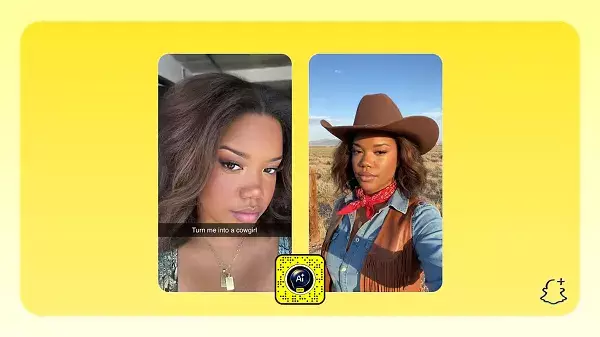
In an era where technology continuously blurs the lines between reality and fiction, social media applications are harnessing artificial intelligence to redefine user interaction. Snapchat’s latest innovation, the “Imagine” Lens, exemplifies this trend by offering users a transformative way to generate and manipulate images with simple text prompts. This feature doesn’t just add a new layer of fun; it fundamentally shifts how we envision personal creativity within digital platforms. Instead of merely sharing moments, users are now empowered to craft entirely new visual narratives, fueling a deeper level of engagement and self-expression.
What sets the “Imagine” Lens apart is its open-ended nature. Unlike earlier filters or AI tools that relied on predetermined scenarios, this function invites users to describe what they want—be it a surreal landscape, a fantastical version of themselves, or an imaginative scene—and see it brought to life instantaneously. This democratization of image creation transforms Snapchat from a basic selfie-sharing app into a canvas for limitless artistic exploration. Although critics might dismiss these generated images as superficial or detached from genuine experiences, the potential for personal storytelling and playful experimentation remains vast and largely untapped.
Challenging the Notion of Authenticity
Despite the excitement surrounding AI-generated content, there’s an underlying question about its place within a social platform traditionally built on real-time, authentic connections. Snapchat, with its roots in fleeting selfies and candid moments, is now venturing into territory that produces entirely fabricated images—crafted by algorithms in response to user prompts. This raises concerns about the authenticity and value of such visuals, which may appear disconnected from genuine shared experiences.
Many might argue that inserting AI-generated illusions into social feeds diminishes the authenticity of online interactions, fostering a culture obsessed with fantasy rather than reality. From this perspective, the “Imagine” Lens could be seen as a distraction—more about entertainment than meaningful connection. But the counter-argument suggests that social media is increasingly about layering identities, exploring different facets of ourselves, and engaging in playful experimentation. In this light, AI-driven tools become instruments of self-discovery rather than deception, offering a sandbox where users can test out new versions of their personas without any real-world repercussions.
However, skepticism remains warranted. As these tools become more sophisticated, the line between genuine and fabricated content blurs further. Will users start valuing the authentic over the artificial? Or will digital personas become so polished and hyper-real that the need for authenticity diminishes altogether? These are critical questions that face not only Snapchat but the entire social media ecosystem.
The Future of Personalization and Social Interaction
What’s undeniably compelling about Snapchat’s “Imagine” Lens is its potential for personalization. Instead of static filters or pre-designed scenarios, users can now craft bespoke images that reflect their imagination and mood. This personalized approach could usher in a new era where social media doubles as a creative playground, fostering greater individual expression.
Moreover, the feature’s design encourages collaborative and playful interactions. Friends can share AI-generated images, compare their imaginative creations, or even challenge each other to come up with the most absurd or fantastical prompts. Such interactions could deepen bonds and spark new forms of social engagement. In an age where technology often isolates, these features might serve as catalysts for genuine connection—if wielded thoughtfully.
Yet, access remains limited—being exclusive to subscribers of higher-tier plans suggests that Snapchat sees this feature as a premium experience. This decision might indicate a broader industry trend: AI-driven personalization and creation as premium offerings that boost monetization while providing a sense of exclusivity. As these tools become more widespread, it’s essential to consider whether they truly democratize creativity or deepen existing digital divides.
Ultimately, Snapchat’s “Imagine” Lens encapsulates a much larger cultural shift—one that champions boundless creativity, blurs perceptions of reality, and redefines what it means to share personal stories in a digital space. Whether this evolution will enrich our social lives or foster superficial engagement remains an open question, but its implications are undoubtedly profound.
 Spanish
  English