
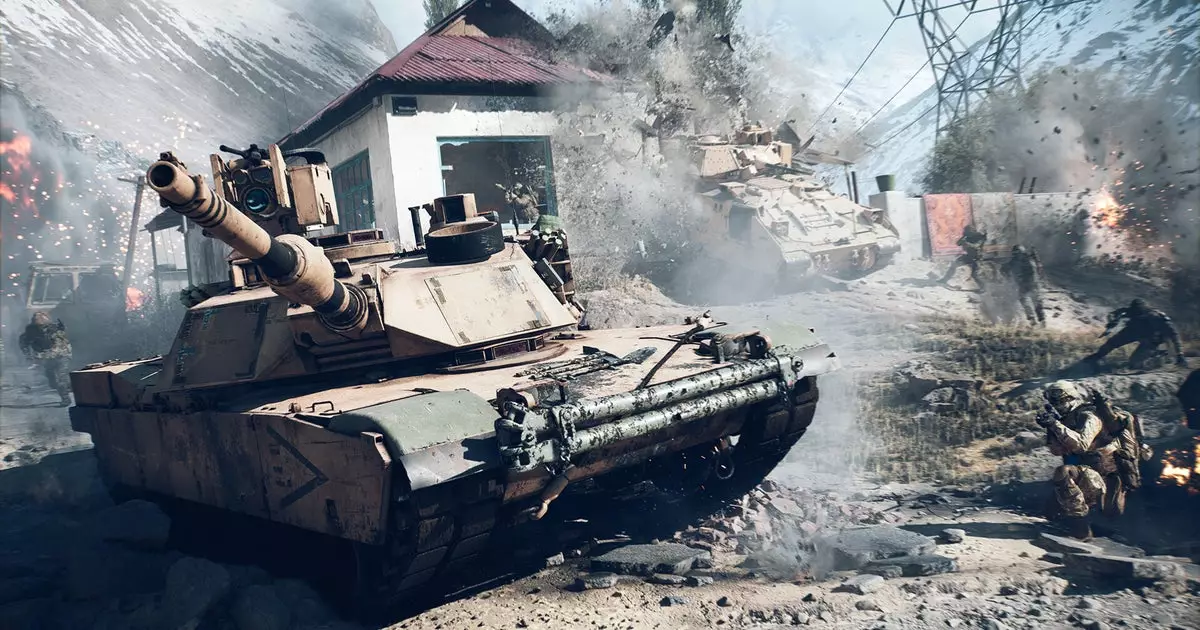
The recent reveal of Battlefield 6’s multiplayer alpha underscores an ongoing challenge within the franchise: how to craft vehicles that feel impactful yet fair in the chaos of warfare. The disconnect between how tanks and helicopters perform versus infantry sets the stage for critical analysis. On the one hand, players often marvel at the prowess of external operators who command these vehicles with surgical precision, slippery yet precise—almost ballet dancers on the battlefield. Conversely, the control experience for gasping players like myself resembles dragging a shopping trolley through molasses, making vehicle combat a frustrating exercise rather than the adrenaline-fueled spectacle one might expect.
This stark contrast begs a larger question: is the problem rooted in the fundamental design of vehicle physics, player skill disparities, or perhaps a deliberate design choice? My gut tells me that the latter plays a role, but the critical issue lies in balancing. Vehicles must feel robust and rewarding, not fragile and flimsy. Otherwise, they risk becoming secondary to infantry—the true backbone of Battlefield—but in a way that tilts gameplay toward frustration rather than strategic depth.
Developer Intent and the Balancing Dilemma
According to Battlefield 6 lead producer David Sirland, the developers intentionally started with a conservative approach, “lowballing” vehicle strengths to establish a solid foundation. His rationale is grounded in the messy reality of multiplayer balance: it’s an ongoing process of iteration, one that confronts the unpredictable creativity of the player base. Here’s where the tension arises. If engineers and anti-tank weaponry are overpowered from the outset, vehicles become irrelevant—just target practice for seasoned players wielding rockets and mines. But if vehicles are too weak, they lose their strategic value, turning maps into infantry playgrounds with little tactical nuance.
What prompts skepticism about this approach is whether intentional underpowered vehicles serve the long-term health of gameplay. The idea of “starting weak” might promote a sense of challenge, but it can also breed dissatisfaction if vehicles never gain enough resilience to be viable threats. Striking the right balance requires more than just numerical tweaks; it demands a nuanced understanding of player psychology, engagement, and tactical diversity. The risk of developers deliberately shipping unbalanced content as a form of long-term balancing gambit might seem cynical but is perhaps inevitable in an ever-evolving game landscape.
The Complexity of Ongoing Balancing in Modern Shooters
Game development is never truly finished; it’s an iterative dance of adjustments. The beta phase acts as a testing ground for the unpredictable behaviors of diverse player groups. The fact that vehicle sponginess varies significantly in different maps hints at an even more complex equation—what feels “weak” in one scenario could be adequate in another. As maps are designed with specific dynamics in mind, physics and vehicle resilience cannot be statically tuned; they adapt to the map’s architecture, player tactics, and emergent gameplay situations.
Furthermore, balancing isn’t just about numbers and physics; it’s about crafting a convincing simulated sandbox. When tanks explode after one or two rockets in trailers, it prompts a superficial perception that vehicles are broken, yet these cinematic depictions ignore player skills and map design. The real challenge is ensuring that vehicles can withstand and dish out damage in a way that promotes strategic gameplay rather than mere chaos.
Player Skill and the Real Cost of Balance
An essential consideration often overlooked is player mastery. The more skilled players become at exploiting terrain, weapon loadouts, and vehicle weaknesses, the more ‘balanced’ game mechanics appear—at least from their perspective. Yet, for newcomers or casual players, the same mechanics can feel inaccessible or unfair. The dilemma for developers is creating systems that are forgiving enough to encourage new players while rewarding experienced ones without creating insurmountable skill gaps.
In this context, the apparent fragility of vehicles might be a symptom not solely of poor design but of the tension between accessible gameplay and competitive depth. An optimal balance would allow vehicles to feel substantial and consequential without tipping into dominance or becoming useless steel coffins. Achieving such a tightrope walk demands continuous tuning and an openness to feedback.
Reflections on the Future of Battlefield’s Vehicle Gameplay
As the game evolves through beta iterations and future testing phases on more vehicle-centric maps, we will see whether DICE manages to refine the elusive art of vehicle balancing. The question remains: how will they reconcile the cinematic spectacle of explosive trailers with the tactical depth necessary for competitive play? Ideally, the final product will feature vehicles that feel powerful without being overpowered, offering layered opportunities for both experienced strategists and casual players.
Ultimately, the ongoing balancing saga reveals a deeper truth about multiplayer gaming—perfection is a moving target. Developer decisions are as much about anticipating player evolution as they are about current metrics. While some may see the current state of vehicle fragility as disappointing, it’s a reminder that game design is a dynamic process. As frustrating as battling a sluggish tank might be at times, it’s part of a broader effort to create a nuanced, engaging battlefield—one that challenges players to adapt, strategize, and ultimately enjoy the chaos.
 Spanish
  English