
In the fast-paced realm of artificial intelligence, moments of true progress are rare but electrifying. Recently, Alibaba’s Qwen team orchestrated such a revolution, unleashing a series of groundbreaking models that challenge the very fabric of AI development. Rather than a single “song of the summer,” they delivered a symphony of innovation—four new open-source models within a week. Each new release not only pushes the envelope but redraws the boundaries of what open-source AI can accomplish, especially in reasoning and multi-tasking domains.
What sets Alibaba’s approach apart is their commitment to specialization. They are not content with one-size-fits-all models; instead, they develop purpose-built systems tailored to distinct use cases. Their latest reasoning model, Qwen3-235B-A22B-Thinking-2507, exemplifies this philosophy. Designed to excel in complex problem-solving, this model embraces chains of thought, self-reflection, and multi-step reasoning, dramatically enhancing accuracy on challenging tasks. It’s a clear testament to Alibaba’s strategic shift toward more sophisticated, focused AI architectures that aim to outperform proprietary giants like OpenAI and Google in flexibility and performance.
Elevating the Standards of Benchmarks and Performance
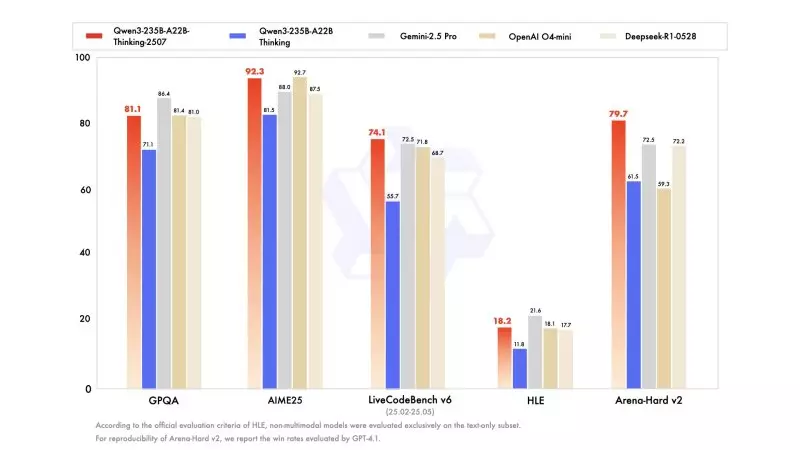
If you measure success by benchmarks, Alibaba’s Qwen series makes an undeniable case. The Qwen3-Thinking-2507 model has achieved outstanding results on a spectrum of tests, placing it firmly in the league of top contenders. In the AIME25 benchmark—an arduous test designed to assess mathematical and logical problem-solving—the model surpasses its predecessor and nearly ties the best models from industry leaders. Similarly, in LiveCodeBench v6, it achieves a score that outpaces both Google and OpenAI counterparts, confirming its robustness in coding and logical reasoning tasks.
Perhaps most impressively, on the GPQA, a graduate-level question benchmark, and Arena-Hard v2, which evaluates subjective alignment, Qwen3’s performance is nothing short of exceptional. It not only outperforms previous versions but rivals—and in some cases exceeds—leading commercial models. This rapid ascent underscores a fundamental shift: open-source models are rapidly closing the gap on proprietary solutions, blurring the lines of AI hierarchy and democratizing access to cutting-edge technology.
Strategic Focus on Specialization and Flexibility
Alibaba’s departure from hybrid models—those that toggle between reasoning and instruction modes—is a bold move. Instead, they opt to develop dedicated models for each purpose. This specialization fosters optimized performance, greater clarity, and more predictable behavior, especially crucial when the models are deployed in enterprise environments. The reasoning model is now entirely focused on problem-solving, chains of thought, and analytical tasks, while other models handle coding, translation, or instruction-following. This layered approach represents a mature understanding: that true AI excellence is rooted in specialization rather than one model to rule them all.
Adding to their impressive lineup, Alibaba has launched models fine-tuned for coding (Qwen3-Coder-480B-A35B-Instruct) and multilingual translation (Qwen3-MT). These models are not mere add-ons but integral parts of a comprehensive ecosystem. The coding model offers support for massive token windows and outperforms GPT-4.1 in specific benchmarks, indicating readiness for complex software development tasks. Meanwhile, the multilingual model, trained on trillions of tokens across more than 90 languages, exemplifies Alibaba’s ambition to foster truly global AI solutions.
Open-Source and Commercial Flexibility—A Paradigm Shift
Perhaps one of the most compelling aspects of Alibaba’s Qwen approach is their licensing philosophy. By releasing models under the Apache 2.0 license, they foster an ecosystem of open collaboration and commercial scalability. Unlike many proprietary solutions or research-only models, Qwen models can be freely downloaded, modified, integrated, and self-hosted without restrictions. This approach is a game-changer for organizations seeking control over their AI infrastructure, especially when considerations around data privacy, latency, and costs are paramount.
For enterprises, the availability of such powerful models at no initial cost and with flexible licensing democratizes AI deployment. The models support a range of deployment options—from on-premises hardware to cloud-based inference—allowing companies to tailor solutions to their specific needs. Whether integrating into existing systems or building new intelligent services, Alibaba’s model suite offers an unmatched combination of performance, transparency, and ownership.
The Road Ahead: An Open-Source Future Empowered by Strategic Focus
Alibaba’s Qwen series exemplifies a bold vision for open-source AI—one rooted in specialization, transparency, and scalability. By releasing models tailored for reasoning, coding, and translation, they are building an interconnected ecosystem that challenges the hegemony of closed, API-reliant models. Their approach fosters innovation at the grassroots level, inviting developers and organizations to customize and scale AI solutions without dependence on proprietary restrictions.
This strategic emphasis on open licensing and technical excellence positions Alibaba as a formidable player in AI’s future landscape. It signals a shift toward a more democratized, adaptable, and enterprise-friendly AI environment—one where control, performance, and innovation go hand in hand. As other industry giants remain locked into proprietary ecosystems, Alibaba’s commitment to open-source models might just redefine what is possible—and desirable—in the evolving world of artificial intelligence.
 Spanish
  English