
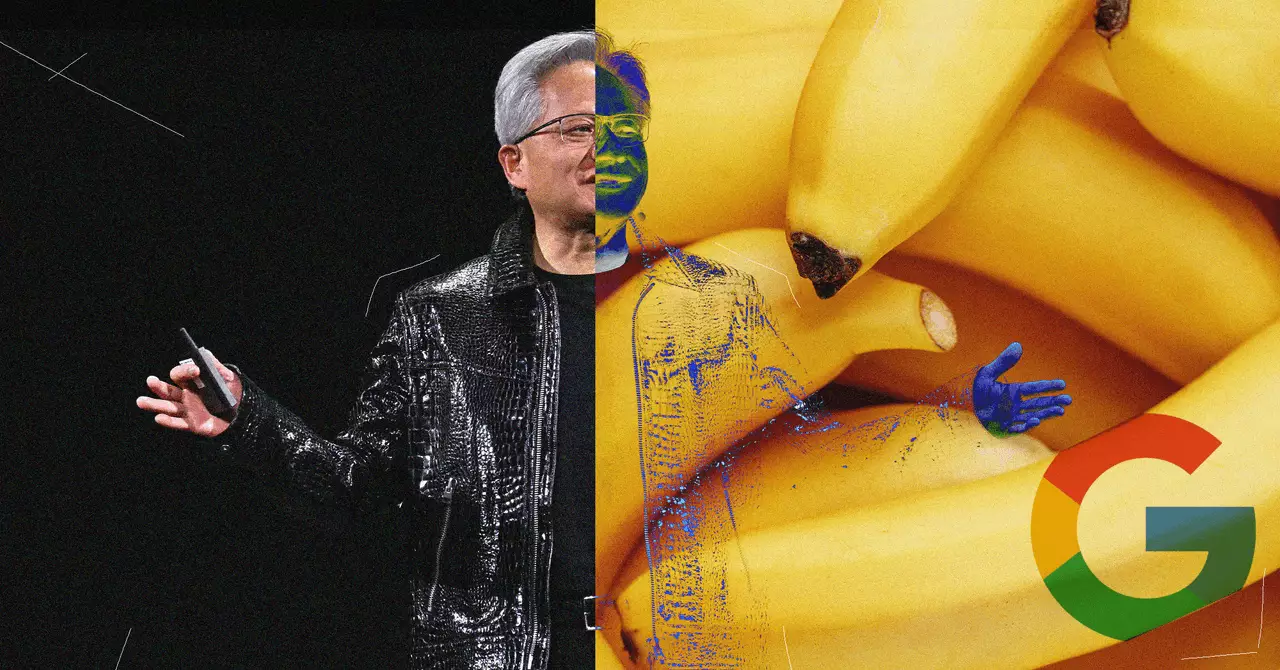
Jensen Huang, the visionary CEO of Nvidia, embodies the relentless drive to push the boundaries of technological advancement. His recent enthusiasm for an emerging AI image generator, Nano Banana, underscores a broader obsession with democratizing AI and making its benefits universally accessible. Huang’s infectious optimism isn’t mere bravado; it’s a strategic declaration of Nvidia’s intent to dominate and shape the AI landscape. As he stands before a crowded room of journalists in London, his admiration for Nano Banana highlights a crucial insight: transformative AI tools are not just technical marvels but catalysts for societal change.
What makes Nano Banana so compelling isn’t solely its impressive capabilities—though preserving facial features and background integrity in AI-generated images is undeniably influential. It’s the symbolic significance of such tools in fostering a new era of creativity and precision. The surge of 300 million images generated post-launch signifies the hunger and readiness of users worldwide to explore AI’s potential. Huang’s unabashed praise reveals his confidence in AI’s power to revolutionize industries, from entertainment to research, fueling a wave of innovation that can redefine how humans interact with technology daily.
Nvidia’s Strategic Investment and UK’s Growing AI Ecosystem
Huang’s visit to the UK isn’t merely about fanboy enthusiasm; it’s a calculated move to strengthen Nvidia’s foothold in a burgeoning AI hub. The company’s recent $683 million investment in data center builder Nscale exemplifies a strategic push to develop the infrastructure needed for next-generation AI services. This move, paired with investments from OpenAI and Microsoft, positions Nvidia at the epicenter of global AI development in the UK.
Beyond financial commitments, Huang emphasizes the UK’s rich historical pedigree in innovation—from the Industrial Revolution to pioneering research institutions. He suggests that Britain’s humbleness about its technological achievements belies its true potential. His playful quip about the UK’s culinary prowess is a reminder that innovation often thrives in environments that celebrate their unique strengths. By fostering local AI research and infrastructure, Nvidia aims to catalyze UK’s evolution into a leading AI power, echoing its ambitions to make AI a universal tool accessible to all.
Personal Use of AI and a Future of Shared Knowledge
Huang’s narrative about his personal engagement with AI underscores a fundamental shift: AI isn’t just a corporate tool but an extension of human capability. His candid remarks about using AI to prepare speeches, conduct research, and streamline decision-making paint a picture of a future where AI assistants aren’t fringe technology but integral partners in daily life. His mention of multiple AI tools—Gemini, Grok, Perplexity, ChatGPT—demonstrates a nuanced understanding of differing AI strengths and the importance of tailored solutions.
This personal perspective is vital because it humanizes AI, transforming it from an abstract concept into an accessible reality. Huang’s assertion that AI can help bridge the global technology divide echoes a broader moral imperative: access to AI should not be reserved for the privileged few. Instead, it must serve as a democratizing force, enabling all individuals to harness its power. His belief that AI is humanity’s best hope to elevate entire societies signals an optimistic yet urgent call for inclusive technological progress.
The Ethical and Societal Implications of AI Democratization
While Huang’s enthusiasm is contagious, a critical examination reveals the complexities beneath his optimistic veneer. AI’s democratization holds undeniable promise, yet it also raises profound ethical and societal questions. Who controls these powerful tools? How do we prevent misuse or unintended harm? Huang’s statement about AI being the “single greatest opportunity” for closing the technology gap glosses over these challenges. Rapid deployment without adequate safeguards could exacerbate inequalities, entrench biases, and threaten cybersecurity.
Furthermore, his celebration of AI as a thinking partner underscores a shift toward reliance—yet it’s essential to remember that AI lacks consciousness and moral judgment. Dependence on AI for decision-making may diminish human oversight and responsibility, potentially leading to consequences that aren’t immediately apparent. Despite his confidence in AI’s capacity to improve work quality and expand knowledge, the societal risks demand careful governance. As Huang envisions an AI-driven future, it’s crucial to balance innovation with responsible oversight, ensuring these powerful tools uplift rather than undermine societal norms.
The Paradox of Confidence and Caution
Huang’s exuberance about Nvidia’s technological prowess and the transformative power of AI borders on visionary zeal. His personal anecdotes about using AI assistants and his humorous remarks about the UK’s reputation highlight a personality that’s both charismatic and driven by a relentless belief in progress. Yet, this confidence carries an inherent paradox. On the one hand, it fuels rapid innovation and investment; on the other hand, it risks fostering a narrative of unchecked optimism that can overshadow the nuanced realities of AI development.
The tech industry often champions a “build first, worry later” mentality, but history reminds us that hasty deployment can lead to unintended consequences. Huang’s claims about AI’s ability to reshape thought processes and decision-making are alluring, but they require a sober acknowledgment of AI’s current limitations and potential pitfalls. To truly harness AI’s power, leaders like Huang must cultivate a sense of humility alongside their enthusiasm—recognizing that sustainable progress depends on thoughtful regulation, ethical considerations, and ongoing societal dialogue.
—
*In the end, Nvidia’s bold vision under Jensen Huang exemplifies both the enormous promise and the peril of AI’s transformative potential. While the allure of democratized, human-enhancing technologies is undeniable, society must remain vigilant, ensuring that innovation aligns with ethical principles and inclusive access. Only then can the true power of AI serve as a force for positive change across the globe.*
 English
  Spanish