
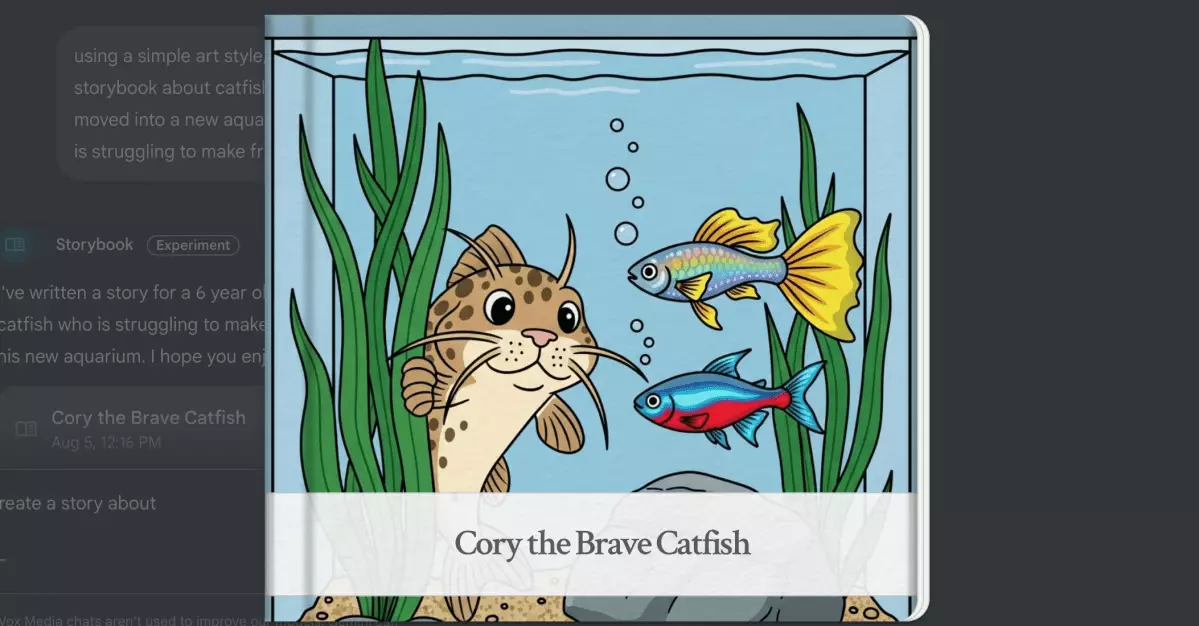
The advent of AI-powered storytelling tools marks a pivotal moment in the evolution of creative media, blending technological innovation with artistic expression. Google’s newest feature within its Gemini AI chatbot, aptly named “Storybook,” exemplifies this fusion by enabling users to conjure up illustrated narratives with astonishing ease. Simply by describing a scene or concept, users can generate multi-page stories enriched with illustrations that match their descriptions and style preferences. The platform’s versatility—allowing customization of art styles, from anime to claymation—embodies a leap towards democratizing narrative creation, making it accessible even to those without artistic skills. At its core, this innovation hints at a future where storytelling is more interactive, personalized, and engaging.
However, beneath this promising veneer lies a landscape riddled with imperfections. As groundbreaking as the concept is, the implementation reveals notable flaws that challenge its potential to replace, or even complement, traditional art and storytelling. While the technology intelligently automates the creation of visual and textual content, it often yields results that are inconsistent or bizarre—occasional glitches that expose the limitations of current AI understanding and artistic interpretation. These imperfections serve as a stark reminder that AI, despite its rapid progress, remains fundamentally a work in progress, and its creative outputs are still subject to unpredictable anomalies.
Understanding the limitations: When AI creativity falls short
A critical analysis of the AI storytelling experience reveals that the technology sometimes struggles with coherence and accuracy, especially in complex scenes or nuanced character interactions. For instance, one story about a fish in an aquarium trying to make friends features illustrations with inexplicable anomalies—such as a fish sporting a human arm or objects that resemble crime scenes. These visual hiccups highlight the AI’s ongoing challenges with understanding context and maintaining consistency across frames. Such errors, while perhaps minor from a technological perspective, undermine the narrative integrity and can diminish user confidence.
Furthermore, the AI’s attempt at artistic emulation is hit-or-miss. When users upload personal images or sketches, the system’s interpretation doesn’t always align with the original essence. An uploaded cartoon cat, for example, might be rendered in a style that clashes with the user’s expectations, acting as a visual mismatch rather than an enhancement. This disconnect between user intent and AI output underscores a crucial point: creativity remains a deeply human trait rooted in emotional nuance, cultural context, and subjective interpretation—a domain AI is still striving to master.
The inconsistencies extend beyond visuals. The narrative coherence in AI-generated stories often lacks depth, relying on simple plotlines that can feel uninspired or cliché. While this is somewhat expected given current technological boundaries, it further emphasizes that AI storytelling tools are better suited as aids or creative prompts rather than standalone creators capable of producing compelling, original narratives on par with human authors.
Opportunities amid imperfections: Learning from anomalies
Despite these shortcomings, dismissing AI storytelling tools as merely novelties would be shortsighted. The ability to generate customized illustrations and stories at whim opens new avenues for creative exploration, especially for children, educators, and indie creators who might lack access to professional artists or writers. For instance, a teacher can instantly craft a personalized storybook for a classroom project, fostering engagement and imagination without significant effort or cost. Similarly, hobbyists and aspiring storytellers can experiment with different styles and ideas, pushing the boundaries of their creativity.
The irregularities and oddities encountered serve as valuable feedback for developers striving to improve the technology. Each flawed illustration or nonsensical story offers insight into how AI interprets complex instructions and where it falters. These anomalies are not just errors; they are lessons that can guide future iterations towards more refined, context-aware AI systems. The current inconsistencies invite a collaborative approach—where human oversight and AI automation work synergistically—helping to mitigate errors and enhance overall quality.
Looking ahead, it’s conceivable that through iterative improvements, AI storytelling will evolve beyond its current limitations. As training datasets expand and algorithms become more sophisticated, AI can better grasp the subtleties of human expression, cultural references, and artistic styles. The potential to generate rich, emotionally resonant stories that feel both authentic and visually compelling is within reach. The key lies in balancing technological innovation with human creativity, recognizing that AI, whilst powerful, will always function as a tool that extends human imagination rather than replaces it outright.
In essence, the current state of AI story creation is a mixed bag—an impressive technological feat marred by imperfections that reflect its nascency. While it offers an exciting glimpse into the future of personalized, automated storytelling, it also exposes the enduring need for human intuition and artistic sensibility. Embracing this duality will be crucial as creators and technologists work together to refine these tools, transforming them from curious novelties into reliable partners in the creative process.
 English
  Spanish